In a recent ruling, the Federal Court of Justice (BGH) has tightened the requirements for advertising using medical quality seals. Strict standards must be applied to the accuracy, unambiguity and clarity of such advertising claims and quality seals – with far-reaching consequences for providers and users of such seals.
The defendant publishes a periodical on health-related topics. Once a year, this magazine features a ranking known as the ‘doctors’ list’. The ‘list of doctors’ consists of an ordered list of various doctors, who are named and, amongst other details, listed with their respective practices. The doctors are assessed in several stages, namely a selection process, a preliminary assessment and a final assessment. Between the preliminary assessment and the final assessment, questionnaires requesting self-disclosure were sent to some of the doctors, in which they were also able to provide recommendations from colleagues. Further evaluation criteria included, amongst other things, patient reviews and self-reports from the doctors. In the subsequent weighting of the individual evaluation criteria, peer recommendations are the most influential criterion. Finally, a plausibility check was carried out using the statistical data.
Based on this ranking, the defendant awards the following quality seals to these doctors:
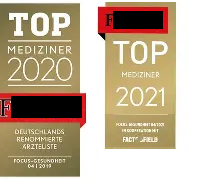
The seal on the left, ‘F. Top Mediziner’, is awarded according to the doctor’s position in the ‘Ärzteliste’. The seal on the right, ‘F. Empfehlung’, recognises specialist doctors in the district where they practise. The doctors recognised by the defendant may use the quality seals for their own commercial purposes (in particular, advertising on their own websites) in return for payment of an annual licence fee to the defendant.
The claimant is challenging the defendant’s offer to licence the quality seals for a fee. In the claimant’s view, the compilation of the ranking itself and the design of the quality seals are misleading. The assessment is not based on appropriate criteria, and the design does not contain any corresponding information.
The Munich I Regional Court ruled in favour of the claimant as sought; however, on appeal by the defendant, the claim was dismissed. On appeal, the Federal Court of Justice (judgement of 30 July 2026 – I ZR 130/25) clarified the applicable legal standard and referred the case back to the Munich Higher Regional Court for a fresh hearing and decision.
Under Section 5 of the Unfair Competition Act (UWG), misleading conduct occurs where the impression created by a statement in the minds of the relevant public (the groups of people at whom the advertising is directed) does not correspond to the actual circumstances.
In the context of advertising using test results, this means specifically: Advertising using test results for products is not misleading if the award conferred by a third party was granted following a reputable procedure and was not obtained by fraudulent means. In this case, the advertiser may use the award and is not required to provide their own proof of quality. Nor are they subject to the strict admissibility requirements applicable to ‘unique selling point’ or ‘top-group’ advertising. It is also permissible for the advertiser to rephrase the test result in their own words, provided that they do not alter the statement of the test result to their own advantage.
The Federal Court of Justice (BGH) is now further developing these principles. Where health-related advertising involves test results, stricter regulations apply. The case law already established regarding health-related advertising (without test results) is being extended to cover health-related test results.
Misleading health-related advertising can pose significant risks to the health of individuals and the population as a whole. Such advertising must therefore meet particularly stringent requirements regarding the accuracy, unambiguity and clarity of the advertising message.
According to the Federal Court of Justice (BGH), the same applies to health-related advertising featuring test results. Merely relying on a reputable testing procedure is therefore not sufficient. The requirements regarding accuracy, unambiguity and clarity must also be met. If there are any restrictions or reservations arising from the testing procedure, these must be stated. This obligation also applies to any test logo based on such a procedure. Any restrictions arising from the test procedure must also be evident from the test logo. If this is not the case, it constitutes misleading information regarding the extent of scientific evidence.
Nor is the application of the stricter regulations on health advertising to health-related test results precluded by freedom of expression or freedom of the press and media. Even if a provider were able to invoke such fundamental rights, freedom of expression and freedom of the press and media may be restricted by a general law such as the UWG. The interference with fundamental rights is justified by the high importance of the interests protected.
In the view of the Munich Higher Regional Court, there was no misleading representation. Advertising using the ‘F. Top Mediziner’ test seal is aimed at the average consumer. Such consumers would understand that the ranking was not carried out by a neutral third party with the relevant expertise. The test seal is not used in a technical field, but only in the context of the subjective assessment of doctors. The criteria for permissible advertising using test results were met, as the seal had been awarded following a reputable procedure. The same applied to advertising using the ‘F. Recommendation’ test seal.
The Federal Court of Justice’s main point of criticism was the fact that the strict requirements for health-related advertising had not been applied. It is therefore not possible to assess whether the test carried out by the defendant meets the strict requirements for accuracy. In particular, it remains unclear
Overall, the Federal Court of Justice concludes that it is currently not possible to reliably distinguish between the assessment of the doctors who received the award and those who did not.
Furthermore, the ‘F. Top Mediziner’ test seal may – contrary to the assessment by the Munich Higher Regional Court – be misleading. The test seal itself does not indicate the criteria on which it was based. It is also unclear which subjective assessments formed the basis for it.
The Federal Court of Justice (BGH) concurs with the assessment of the Munich Higher Regional Court, according to which the relevant public assumes that the assessment of doctors is subjective in nature. As a next step, however, it must be specified which subjective assessment is decisive. It is of considerable importance for the informative value of a test logo whether it depends on the assessment of medical colleagues (third-party information), solely on a self-assessment, or on the assessment of patients. If, as in this case, the ranking is based on and combines all these types of assessment, this suggests that it is misleading.
This line of argument also applies to the ‘F. Recommendation’ test seal. According to the Federal Court of Justice (BGH), there is no assessment of the fact that the doctors’ self-reports were also taken into account for the ranking. Once again, the limitations associated with the testing procedure are not made clear by the test logo. The relevant public therefore perceives the test seal as conferring greater professional authority, which influences their choice of doctor.
Furthermore, the BGH points out that any spatial constraints inherent in the chosen means of communication (e.g. limited space for information) are irrelevant when assessing whether the information is misleading. This circumstance can only be taken into account when assessing a breach of information obligations (Section 5a of the Unfair Competition Act (UWG)).
Finally, in the BGH’s view, further findings are lacking, meaning that a possible case of unfair misleading cannot be conclusively assessed. In any event, misleading cannot be ruled out on the basis of the facts established so far.
Although the Federal Court of Justice (BGH) has not reached a final decision on the matter, the judgement is of considerable practical significance. The decision makes it clear that, in future, the use of health-related test seals will require thorough legal scrutiny. Both providers and users of such awards should ensure that the advertising message is accurate, unambiguous and clear. This requires a suitably rigorous and transparent testing procedure and an appropriate design of the test logo. Any restrictions or reservations arising from the testing procedure must be sufficiently apparent from the test logo itself.
The ruling explicitly applies only to the field of health advertising. For other areas of advertising, the general principles governing the use of test results in advertising continue to apply. According to these principles, it is particularly important that the award was granted following a reputable procedure and was not obtained fraudulently. In practice, this means that test seals should not be adopted without verification. Rather, it is always necessary to check which legal requirements apply to the relevant advertising sector and whether the underlying test procedure meets these requirements.
(Federal Court of Justice, judgement of 30 July 2026 – I ZR 130/25)






Subscribe to our GvW Newsletter here - and we will keep you informed about the latest legal developments!