The scope of protection of a registered EU design may be extremely limited if the visual features of the protected product are largely dictated by its technical function. In a preliminary ruling on this matter, the Higher Regional Court of Nuremberg provides several practical indicators by which technical necessity can be determined in individual cases.
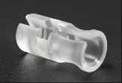
The claimant was the proprietor of a registered EU design for individual pipe seals – small plastic sleeves with rubber sealing elements, which serve to seal the ends of fibre-optic micro-tubes in a gas- and watertight manner, thereby protecting underground telecommunications networks against external influences. The product is aimed exclusively at specialists and is no longer visible once it has been installed underground or in distribution boxes.
 |
 |
 |
|---|
The claimant challenged two of the defendant’s designs – a transparent and an opaque variant – and based its action for infringement on the registered design.
 |
 |
 |
 |
|---|
The Nuremberg-Fürth Regional Court dismissed the claim and found that there had been no design infringement. The Nuremberg Higher Regional Court issued a judicial notice to the claimant during the proceedings (notice order of 22 October 2025, 3 U 1028/25) pursuant to Section 522(2) of the Code of Civil Procedure (ZPO), following which the claimant withdrew its appeal.
Article 8(1) of the EU Design Regulation (UGV) stipulates that an EU design shall not subsist in features of a product which are ‘determined exclusively by its technical function’. The purpose of this provision is to prevent technological innovations from being hindered by the monopolisation of technically determined features of appearance through design law, without complying with the strict requirements of patent law.
It is important to note that Article 8(1) of the EU Design Regulation not only provides a complete ground for exclusion from protection for the design as a whole, but also functions as a so-called ‘ground for limiting protection’. This means that even individual features of a design which are technically determined must be ‘disregarded’ when assessing the scope of protection and any infringement. Any similarities between the design in suit and an alleged infringing embodiment in such technically determined features are of only minor significance for the overall impression created in the mind of the ‘informed user’ – which is the standard under design law for assessing the overall impression.
Since the landmark ruling by the ECJ in the ‘Doceram’ case (ECJ, judgment of 8 March 2018, C-395/16), it has been clarified that, for the purposes of assessing technical necessity, the decisive factor is whether the technical function is ‘the sole factor determining these features’. The ‘theory of design diversity’, previously held in some Member States – according to which the mere existence of alternative designs could preclude protection – was expressly rejected by the ECJ.
Even if there are other designs that could fulfil the same technical function, the exclusion from protection applies if considerations of a different nature – in particular those relating to the visual appearance – played no part in the specific design.
In making this assessment, case law focuses on objective circumstances: the design in question itself, information on the use of the product, the reasons for choosing the visual features, and the existence of alternative designs – provided there is sound evidence to support this.
In its ruling, the Higher Regional Court of Nuremberg identified several pieces of evidence pointing to technical necessity:
Technical purpose
A strong indication is the technical purpose of the product. In the case of purely technical products which are purchased and installed by specialists, it can be assumed, based on common experience, that their function, technically feasible qualities and price ensure their value and marketability, whilst design considerations are entirely secondary.
Parallel patent application
A further indication is that the features of the design in question are depicted and described in a patent application filed by the proprietor. The correspondence between the embodiment shown in the patent specification and the design demonstrates that the proprietor herself attributes specific technical advantages to the design. Claims, descriptions and drawings in a (patent) publication are, in principle, suitable as objective circumstances for providing information on technical conditionality.
However, it should be noted that the mere existence of a patent application does not automatically establish the technical basis of the design. There is no rule of thumb to suggest that considerations relating to visual appearance played no part in a feature described in a patent application. Rather, it must always be examined whether circumstances outside the patent application indicate a visual basis.
Advertising emphasising technical functions
The manner in which the design proprietor promotes the product is also relevant. If, in its advertising materials, the holder emphasises exclusively technical and functional aspects – and specifically not a particular design appearance – this is a significant indication that the motives for choosing the design features were of a technical nature. Furthermore, advertising messages reflect the expectations of potential buyers.
Invisibility when used as intended
The Higher Regional Court of Nuremberg attaches particular evidential significance to the design being non-visible when used as intended by the end user. The Senate argues that, in the case of technically oriented products which, by their intended use, are not meant to be visible – for example, because they are installed underground – it must be assumed that design considerations played no part in the creation of their appearance.
Admittedly, the Utility Model Act (UGV) only recognises a formal visibility requirement as a condition for protection in the case of components of complex products (Art. 4(2)(a) UGV). However, in the opinion of the Higher Regional Court of Nuremberg, the underlying legal principle – that there is no justification for granting a monopoly right for designs that remain concealed during normal use – is transferable to the assessment of technical necessity.
Result: Extremely limited scope of protection
In the specific case, a detailed analysis of all nine defining features of the design in question (cylindrical sleeve, concave grip section, sleeve slot, blue colour in accordance with DIN standards, through-channel, longitudinal slot, conical shape, symmetry and positioning tab) revealed that these were overwhelmingly purely functional and technically determined. The scope of protection of the design in question was therefore to be regarded as ‘extremely limited’.
Consequently, even minor differences between the design in suit and the contested embodiments were sufficient to create a different overall impression on the informed user – with the result that no design infringement had taken place.
The identification of specific indicators by the Higher Regional Court of Nuremberg – albeit somewhat vague from a doctrinal perspective – is certainly helpful in practice as a guide for distinguishing between technology and design. However, in corporate practice too, when assessing design protection, a careful distinction should be made between ‘technically determined’ and ‘exclusively technically determined’ visual features. After all, the legal standard set out in Article 8(1) of the Utility Model Act (UGV) requires that the technical function be the sole determining factor of the design – it is therefore not sufficient for technical considerations merely to have been ‘in the foreground’. Only where design considerations have played no part whatsoever is the exclusion from protection applicable.
The standard applied by the Higher Regional Court of Nuremberg – and, to some extent, also by the Higher Regional Court of Frankfurt am Main (Higher Regional Court of Frankfurt am Main, judgment of 4 October 2018, 6 U 206/16) – according to which, in the case of technical devices, it is generally to be assumed that the designer is bound not only by technically necessary but also by technically ‘appropriate’ solutions – should be treated with a degree of caution. This is because the Federal Court of Justice (BGH) had already clarified in 2021 that an ‘aesthetic surplus’ is irrelevant, simply because aesthetic content is not one of the requirements for protection of an EU design.
To put it somewhat more bluntly: design rights – provided the design is novel and has individual character – also protect even the most blatantly unattractive designs. In this respect, even iconic beauty cannot justify design protection if the aesthetics are merely a consequence of an (exclusively) technical solution.
The decision of the Higher Regional Court of Nuremberg serves as a helpful reminder for all companies wishing to secure ‘technical products’ through design protection. The following practical lessons can be drawn, particularly for small and medium-sized enterprises active in industrial and supply chain manufacturing:
1. Plan your design strategy at an early stage: Anyone developing a technical product and seeking design protection should document, as early as the development process, that design considerations – not just technical ones – have been incorporated into the design, and specify which ones. Internal design briefings, alternative designs and records of design decisions can make all the difference in the event of a dispute.
2. Exercise caution when combining design and patent protection: A parallel patent application for the same product is a strong indication that the design is technically determined. Companies should carefully consider whether, and if so how, they should protect design features via both a patent and a design right – and, where in doubt, clearly distinguish between which features are technically driven and which are driven by product design (not ‘aesthetics’).
3. Design advertising thoughtfully: Anyone who promotes their product solely on the basis of technical advantages provides a competitor with an argument to challenge the design protection. It is advisable to highlight design aspects in product communication as well, provided these actually played a role in the development.
4. Consider visibility: For products that are no longer visible once installed, a narrow scope of protection must be expected. In such cases, it should be assessed whether alternative protection strategies – such as technical property rights (patents, utility models) or competitive performance protection – are more suitable.
5. Realistic expectations regarding enforcement: Even a design that is formally valid under the law will only confer a narrow scope of protection if its features are predominantly technical in nature. In such cases, even minor deviations by a competitor may be sufficient to undermine an infringement claim.
(Higher Regional Court of Nuremberg, reference decision of 22 October 2025, 3 U 1028/25 – Single-pipe seal)






Subscribe to our GvW Newsletter here - and we will keep you informed about the latest legal developments!